Showing posts with label QRFU. Show all posts

Sunday, March 19, 2023

Nov. 8th, 1924: Westmount (Montreal) 02 @ Rideaus 15

The summary below is for the first of a two-game series between the junior QRFU's Rideaus and Westmount for that union's championship. The winner would earn the right to play for the Dominion title.

McInenly below, first name Bert, was singled out for quality play by the article's writer prior to the quarter-by-quarter breakdown copied here. 

St. Germain, meanwhile, was named Ralph, and was in the early days of what would be a distinguished athletic career, as evidenced by his write-up in the McGill Hall of Fame


There's an obvious error in the article below as the first paragraph suggests that Westmount lost the point they earned in the first quarter.

Laishley below was named Lyle, while Bruce's first name was Stewart.


That would be Clyde Moran getting into the action in the fourth quarter.


Rideau would travel to Montreal the following weekend and lose 12-06 but still win the series on total point and therefore secure the QRFU junior title. A battle against Hamilton loomed on the march towards the Dominion championship.


Monday, May 31, 2021

What's Constitutes "Rough Play" Anyway?

After taking a long look at the origins of the Rough Riders name yesterday, I now feel like going back a little further to determine how they earned the rough rider reputation before earning the nickname.

The Ottawa City Football Club was kicked out of the Quebec Rugby Football Union in 1897 for rough play. If that didn't set the perception of the team being particularly...feisty...it must have at least cemented it.

What were they accused of, exactly?  Let's have a look.

Ottawa's City team and Ottawa College, now the University of Ottawa, had a natural rivalry but things boiled up one November evening during one of their contests.

Before we go any further, let's have a basic line-up handy for quick reference when the injuries start piling up.


Officially, the game resulted in an 8-8 tie, though that score was disputed. The team that would become the Rough Riders felt that College was awarded a two-point safety when they actually had only earned a single point on the play, which would make the score 8-7 in favour of the city team. 

But that wasn't even the controversial part! 


It's not clear why Smellie was targeted. His name doesn't even come up in the Journal's summary of the first game between these two teams held on October 16th. I don't believe he played. 

The Montreal Gazette also reported on the game, including an incident in which Walters of Ottawa struck an official. 


It's easy to make a case for Walters to be suspended and even expelled from the league altogether, but the club as a whole? Consensus seemed to be, at least locally, that both clubs were equally responsible, especially since Ottawa's Smellie was assaulted within seconds of taking the field. 

Accusations of rough play came from McGill as well, which is odd since there is actually no mention of any such incident in summaries of that game, played two weeks earlier, even in Montreal newspapers.

In that contest, McGill was ahead 18-01 in the second quarter. Ottawa came back and took a 20-19 lead. And yet, when the game had to be called due to darkness...It was declared to be a 19-19 draw. Go figure. 


Back to the Ottawa City/College game, the QRFU heads agreed to meet the following Wednesday to discuss the events of that day. McGill, according to one report, wanted the Ottawa Club gone and failing that, they certainly didn't want to meet them again.


And yet, that's precisely what happened. Walters was expelled from the Union and the City Club was suspended. No action was taken against College. 

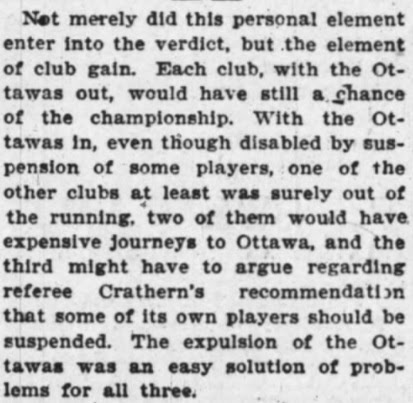
As one Ottawa newsman pointed out, Ottawa City's fate was in the hands of its accusers and all three voting clubs stood to benefit from voting a certain way. 


Yeah, that worked out nicely for everyone...else. Ottawa City had already had the results of two its apparent victories turned into ties and yet was still comfortably at the top of the standings. Getting rid of them reset the race between the remaining three teams, so to speak.

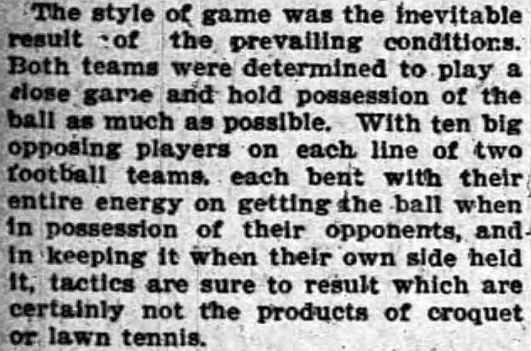
The Montreal papers, for the most part, treated the result of the vote like unfortunate business that had to be done to send a valuable message that rough play would not be tolerated.

The Ottawa media was unsurprisingly upset at the suspension. The Ottawa Club was initially shocked but rather than fight the decision or attempt to retaliate, they appear to have just accepted the matter and looked towards the future. They would join the Ontario Union in 1898 rather than return to the QRFU.

Outside media were of the opinion that the ruling made the QRFU appear "ridiculous" (Toronto Star) and one-sided in avoiding punishment for Ottawa College when they were said by the game's referees to be equally guilty (Hamilton Spectator and Hamilton Times).

A year later, the Hamilton Herald would refer to them as thugs and murderers. 😁  Life came at you fast in 1898 too! 

Sunday, May 30, 2021

That Whole Name Thing

One of the more interesting aspects of researching football history directly from media reports from the time is the frequency with which you find that things thought to be common knowledge are completely inaccurate or at least open to debate.

There are already several examples on this blog, none of which I deliberately sought to find. Rather, while trying to support or add to a certain claim, I instead found myself questioning it. These include...  

  • The CFL lists four draft choices for Ottawa in 1952 when there were at least twice that
  • Tom Clancy is often named as the Ottawa Rough Riders coach for 1904 but looking more closely into it, that seems doubtful
  • The Rough Riders are often said to have "changed names" to Senators for the 1925 and 1926 seasons but the headline announcing the team's Grey Cup victory that first year makes that claim easily questionable.

So let's stay with the name thing...
The club adopted the name Ottawa Rough Riders on Friday, September 9, 1898, and changed its team colours to red and black. Since then, red and black have been Ottawa's traditional sporting colours. Although in later years the name was said to derive from logging, the team based its colours on Teddy Roosevelt's regiment in the Spanish–American War, which, with the date of the renaming, suggests that the name also comes from the war. The team changed its nickname to Ottawa Senators from 1925 to 1930.
That's from Wikipedia and its source is the 2009 Canadian Football League Facts, Figures & Records book. One could reasonably expect it to be reliable but I think a lot of it is based on assumption.

Let's start at the beginning; The club indeed held its annual meeting on September 9th, 1898, but neither newspaper of the time, the Journal and the Citizen, makes any mention of a new name being adopted. In fact, the Journal's report's headline is "Ottawas Are Ready For Rugby". The first practice was held the following Monday and articles about that also made no mention of a new name. The Citizen referred to the team as the "Ottawa Football Club" specifically in its recap of that first practice. 

Let's also bear in mind that on November 10th, 1897, the Ottawa Football Club was suspended from the Quebec Rugby Football Union for "having played roughly against (Ottawa) College last Saturday and for having been rough in the match here against McGill".

The above is from the November 11th Citizen. The match against McGill was in Montreal. McGill was believed to be pushing hard for Ottawa's expulsion (more so than "College", which was a reference to Ottawa U. ) from the QRFU and threatening to refuse to play their scheduled game in Ottawa. The Journal added that an Ottawa City player named Walters also attempted to assault officials during the game against College.

So Ottawa joins the Ontario Union instead. Problem solved. Until...


This may be the first instance of the Rough Riders name being put in use...sort of.  It's not capitalized so it obviously was not an official name, it was meant more as an insult. 

What prompted said insult? You'll note that this partial article is copied to Ottawa papers from the Hamilton Herald. Evidently, Hamilton media types were upset at Ottawa handing Hamilton a loss and accused them of rough play again, the very thing that got Ottawa bounced from the Quebec union less than a year earlier. 

Issues of the Herald from that era are not available (at least to me, at the moment). Here's how one Ottawa paper described the game between Hamilton and Ottawa from the previous Saturday that had that Hamilton writer all riled up.  


Nicely said! 😄

Before we go on, we would benefit from seeing the lineup. 


The above will be beneficial when reading the summary of violence that took place on that fateful Saturday.  


Hey, there's Walters again! I'm going to start thinking of him as the OG Rough Rider.

All that took place during the first match-up between these two teams, in Ottawa. It seemed as though Ottawa was mostly on the receiving end, though that may have been the local bias at work in reporting it.

Ottawa had to travel to Hamilton about two weeks later. They did so and won that contest as well.


Murderers might have been a little strong...

From that point on, the name Rough Riders comes into play frequently in the Ottawa papers. It's hard to believe that the name was decided upon at the annual meeting in September but didn't appear in a local newspaper until one of them decided to copy a Hamilton writer's article six weeks later. It seems more likely that after someone in Hamilton got his nose out of joint over the result of a game and used that term derogatively, Ottawa media (and the team) embraced the club's renegade image and ran with it. I'm reminded of the Millwall soccer club's "No one likes us, we don't care" chant, as an example. 

Why did that Hamilton writer get so bent out of shape, anyway? Surely it wasn't the first time he was exposed to rough tactics while covering a game.


Oh.

As far as the mention of Roosevelt's Rough Riders goes in that Wikipedia article, I've never seen a quote or report to the effect that our Rough Riders had anything to do with his (but if do, I'll add it here). There were a great many articles about Roosevelt's RR at that time so it would have been an easy assumption to make but the names appear to be independent and with completely different meanings.

Sunday, April 4, 2021

1931: Ottawa Rangers 24, Quebec "Swimmers" 07

The Ottawa Rangers, nicknamed "blue shirts" on occasion, were not around very long but they may have left a very specific mark on football in the region.

They began play on 1930, officially, in the Quebec Rugby Football Union, posting a 3-3 record. Under Leo Gleeson the following year, they won four contests, lost two, and reached the semi-finals. 

That semi-final game turned into an exhibition of the forward pass. It was not the first instance of the forward pass being put in use, that took place in 1929, according to the CFL website:

1929
CRU adopted use of the forward pass on a limited basis in Junior, Interscholastic, Western Canada Rugby Union, Western Intercollegiate Union and the Grey Cup final. First legal pass in Canada was thrown by Gerry Seiberling and the first reception was by Ralph Losie of Calgary Altomah-Tigers against Edmonton on September 21... 

1931
CRU approved the forward pass for all leagues and the first TD pass in Grey Cup history was a Warren Stevens to Kenny Grant play in Montreal's 22-0 win over Regina. Convert scrimmage line was moved to the five-yard line, and the point could be scored by a drop-kick, place kick, run or pass.
...but the semi-final game summary certainly makes it sound like its first heavy usage in a game and perhaps the game in which it became better accepted as an exciting feature.


The Rangers scored another unconverted touchdown in a drive that began at their own 40 to take a 12-00 lead. Arnie Morrison punched that one in, he of the "lifetime ban" for his involvement in a brawl in 1929 following a game against the St. Thomas Tigers while he was a member of the Rideaus


The final Rangers touchdown came off an interception return by Clair Forster.

Now this makes me want to track down the first recorded forward pass by an Ottawa team. If if wasn't in this game (and I doubt it was) it had to have taken place no more than weeks prior to this game being played. Let's see what we find. 

Sunday, February 14, 2021

The End Of The Rideaus

The 1928 Junior City League championship (see earlier post) would not be the last for the Rideaus but 1929's would be.

The 1929 Rideaus were a scrappy bunch, to a fault. They started the season with a victory, predictably, against the South Ottawa Roamers and two weeks later found themselves challenged by a revived St. Brigid's club. They didn't take well to it.


They would continue their winning ways throughout the season, gathering a 5-0 record and securing first place. For the fifth time in a row, they would meet Montreal AAA for the QRFU championship but at long last, they won that two-game series by a total score of 17-14.


Way to go, Basil! 

The Rideaus continued their march towards the junior national championship when they defeated the University of Toronto 10-01 at Lansdowne Park. Two weeks later, they met a team from St-Thomas in the national semi-final and that's when things went south for the "Paddlers".

The St-Thomas Tigers won 10-05 and the Rideaus' "fighting" label from the article above would become prophetic. As the game was getting away from the Rideaus, one of the players got heated against a ref and things quickly got out of hand. 


The above description is from the December 2nd, 1929, Ottawa Citizen. The Ottawa Journal adds what might be an important detail.

It appears that while Johnson was being told to leave the field, "suddenly Umpire Bailey staggered under the impact of a blow to the face". In other words, the mob wasn't triggered by Johnson's behaviour towards Foster but by whoever corked Bailey. 

Whatever the case may be, the Rideau Aquatic Club was deeply embarrassed by the whole event and the following day apologized to all involved and withdrew from all sports not aquatic in nature. Just as well, the Canadian Rugby Union suspended them indefinitely later that month. 


Just like that, the top junior team in the city was done.

The following year, a team called the Ottawa Rangers, (not) coincidentally wearing the same colours, would emerge  but that's a story for another day.

As for Arnie Morrison's "lifetime" ban, it didn't hold up particularly well. He was reinstated in 1931, played for the Ottawa Rough Riders from 1933 to 1938 and would later coach Carleton's football team during its formative years. That's how you overcome a ban!

Friday, February 12, 2021

1928: "The Most Sensational Upset Of All Time in Junior Rugby In The City"

If you are particularly observant, you will have noticed a page in the banner above that appeared a few weeks ago and has changed names numerous times since. At this time, it bears the name "Junior QRFU (1918 - 1928)" and it will continue to change as I add seasons at the back end. 

The "Defunct Teams" page includes (at least for now) some details about a team from the Rideau Aquatic Club then often referred to as simply the Rideaus. While that team was undeniably the most successful of its little league, it didn't seem quite fair to ignore all the others. So instead of focusing on the Rideaus only, I started a page specific to the league in which they all participated.

The Rideaus were not a charter member of the league, entering it only in its second season in 1919. The league became affiliated with the Quebec Rugby Football Union the following year.

In short order, Rideaus became dominant to the point that some found it detrimental. While they constantly won the local title with ease, they fared very poorly against outside competition. Some speculated that this was due to a lack of a proper challenge in its own league.

Then in 1927, a team from Ottawa College joined the circuit and in 1928, they shocked the junior rugby football world (well, at least the local one) by defeating the Rideaus, breaking the "Paddlers'" 29-game local winning streak in the process!

The game is recapped below, as is the other game played in the four-team league that day, a matchup of the Ottawa South Roamers and Gladstone. 


As exciting as the win may have been as it happened, it would turn out to have little impact. Rideaus won the rematch 18-00 a few weeks later, and every other match on their schedule for that matter, to collect a 5-1 record. Ottawa College would stumble in overtime to the Ottawa South team in the last week of the season to be knocked off the top spot in the league at 4-2. 

And so this was the sixth straight city championship for the Rideaus and they would get skunked against the Montreal AAA team in the QRFU playoffs for the fourth year in a row, too. The City Junior League was pretty much business as usual in 1928, except for that one game which rattled the cage for a while.

Monday, January 27, 2020

The Shortest Championship Season Ever

The Ottawa Rangers played at the intermediate level in the early 1930s. I'm going to look into their origins more closely at a later time but for now I want to review the back end of their existence.

In 1934, the Quebec Rugby Football Union was struggling. There was some question as to whether it would even attempt to play a season, at least at the intermediate level. They decided to proceed after all, with the plan being that two sections (divisions, basically) of four teams would compete to determine a champion.

Things clearly deteriorated from there because Ottawa was given a bye...for the entire regular season. Only two exhibition games were scheduled and of those, only one came to pass. The article below is from October 12th of that year.


Canadian National would win their section and take a trip into town for the "play downs". So not only did Ottawa make the playoffs without playing a single regular season game, they hosted it!


Emerson Ogilvie. Remember him? He was the guy who entered "The Gallery of the Gods" with his performance for Glebe in the 1927 high school championship game.

The intent was for this to be a semi-final game, but things didn't quite work out that way.


So by virtue of winning the single contest in which they participated, Ottawa Rangers won the championship.

But that would not be enough for our plucky Rangers! They challenged St. Thomas for the Dominion championship!


That game was played on December 9th on a frozen field. Go figure. Ottawa lost 5-2, the two points being scored off the foot of football god Emerson Ogilvie.

Recently, I was impressed that the Ottawa Sooners played 16 games in order to secure a national championship in 1974. At the other end of the spectrum, no one will ever win a championship in fewer games that our 1934 Ottawa Rangers.

I have not located any results for the Rangers in 1935 so evidently, they went out (Québec) champions.

Sunday, January 26, 2020

Let's Show Some Love to St. Brigid's

The Ottawa Football Club executives began the formation a four-team football league in 1918 with the goal to develop local talent. Among the teams to come to life was St. Brigid's.


The league had issues around field availability in its early days. They managed a brief season and its initial championship was eventually won by Ottawa Collegiate.

The league grew to six teams in 1919. The purple, green and white clad St. Brigid's club would win all five of its games and take the championship that season. They were coached by Ottawa Sports Hall of Fame and Canadian Football Hall of Fame inductee Sylvester "Silver" Quilty.

In 1920 the city league, now back down to four teams again including St. Brigid's, became a "section" of the Quebec Rugby Football Union.

Brigid's went undefeated (6-0), secured the city championship, then played Westmount in a 2-game series to determine the QRFU champ. They won both games in the series as well by a combined score of 31-15. Their only defeat would come to the Hamilton Tigers Seconds in the Canadian Rugby Union intermediate finals.

St Brigid's would apply to add a senior team in the Ontario Rugby Union in 1921. Over the next couple of seasons, they would struggle against teams from Toronto.

The junior version would continue for a while but the senior club would serve its purpose of improving the Ottawa Rough Riders in an entirely different way. In 1923, it merged with the Big Four entry.


At this point, Ottawa had not won a championship since 1909 and was coming off a season in which they'd posted an 0-5-1 record. Quilty's team would only improve that mark to 1-5 in 1923 but Dave McCann assisted with the coaching and during practices.

McCann became a coach in 1924 (along with Walter Gilhooley who seems to get very little credit). They again showed slight improvement, putting together a 2-4 record, but optimism was still high, as seen in the November 18th Ottawa Citizen..


Indeed, they would win championships in consecutive seasons in 1925 and 1926 under McCann's leadership. Quilty and McCann both entered the Canadian Football Hall of Fame in 1966.

This is an era that I find somewhat misrepresented in "official" historical reports. It is often said that the Rough Riders changed their name to Senators in 1925 as a result of the merger with St. Brigid's. Clearly that is not the case since the merger actually took place in 1923. The Senators name was in use that year as well, on occasion, but Rough Riders also was used to refer to the club.

In any event, similarly to the Ottawa Trojans merging with the Rough Riders in the mid-40s in order to (among other things) improve the latter club, St. Brigid's did the same two decades earlier.