Showing posts with label 1910s. Show all posts

Friday, August 5, 2022

Backups vs Juniors, 1919 edition!

Today's offering is a glimpse at a couple of games played in the local junior league more than a century ago.

These were the final two contests of the regular season in this league which was on the verge of becoming affiliated with the Quebec Rugby Football Union the following year. Being that the summary is relatively easy to read and includes the line-ups as well as the standings, I thought it would be a good share.


The next scheduled game, largely meaningless between Senecas and New Edinburgh, never happened. In its place, an exhibition was organized between the city's Interprovincial Rugby Football Union team's "seconds" (basically the Rough Riders practice roster, though not making much use of the name at that point) and a team made up of junior league all-stars.

I believe the Seconds had won the QRFU title at their level and were waiting to see if a contest against another union could and would be scheduled. 

In the meantime, final standings within the junior ranks were being settled by...coin flip. 


Congratulations on that third place finish, New Edinburgh! It was well-earned!

The juniors apparently represented themselves quite nicely in their loss to the IRFU club's back-ups. You can read about that below. 


Monday, June 21, 2021

Returning To The Field, Part 2: 1919

Various football unions ceased operations as World War I began, including the Interprovincial Rugby Football Union (Big Four). With the end of that conflict in late 1918, play would resume in 1919.

League and team executives met in Montreal on July 26th to work out rules changes, a schedule, etc. Expansion was considered but decided against.

The season would open with Ottawa meeting Montreal in the capital on October 4th, a game the home team won 10-03. 


It turned out to be premature to label them contenders. They defeated Toronto the following week (also at home) but lost their remaining four contests to fall to 2-4 on the season and last place in the union. 

What's this about Martin Kilt and a protest? I had to go back to mid-September to find an answer to that.


There was some disagreement about Kilt's eligibility to play but Ottawa claimed to have as many as three telegrams from the IRFU's board of directors confirming that he was good to go. I doubt that whole protest thing went anywhere, but now I'm curious about this altercation with this Ben Simpson guy. Might just need to look that up.

Monday, February 17, 2020

We Should Know More About...Tom "King" Clancy

We should know more about Tom Clancy not just because he was a successful, influential figure in the late 1800s and early 1900s but also because an important aspect of his career is often reported incorrectly.

Many lists of Ottawa Rough Rider coaches name him as the team's coach starting from 1904. That does not actually appear to be the case and if not, then the win-loss record credited to him would also be wrong.

Let's work our way down his career and piece it all together. His obituary (he passed away in September of 1938) states that he joined Ottawa College in 1892, apparently because he was drawn to their baseball team. He was considered an outstanding center and his U. of O. teams won national championships in 1894, 1896 and 1897. He planned to stop participating in 1898 but returned as a player-coach.

Ottawa Journal, October 18th, 1898: "The College (vs) Granite game next week should be a corker. Tom Clancy will practice and coach the college team every day this week."

His continued presence would have an inspirational impact on the team.

Ottawa Journal, October 24th, 1898:


He finally would pull the plug on his College playing days in late 1899.

Ottawa Journal, December 16th, 1899:


He was named President of the Rugby Football Union that year in 1901 but was back on the field by 1903. That year, Ottawa U. lost the championship game to the Rough Riders by a score of 13-12. Clancy played in that game for the garnet and grey, scoring a touchdown that was unconverted.

Clancy continued in his coaching role with Ottawa U. in 1904. He was only involved in Ottawa Rough Riders matches as a referee.

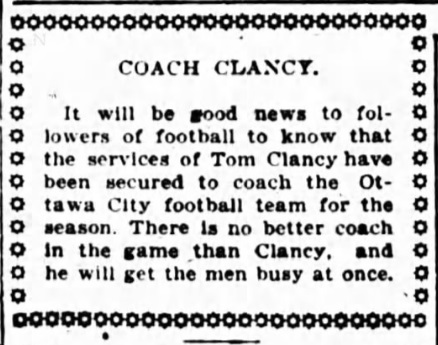
Then in 1907...

Ottawa Journal, October 2nd, 1907:


Ottawa Citizen, October 2nd, 1907:


He would hold the post through most of the 1911 season. He had planned to retire from the position in 1910 because he had been named president of the Big Four and did not want a conflict of interest but he was persuaded to return.

Beyond 1911, he contributed to the sport as an executive and as a referee. He was involved with the Rough Riders in 1919 but more as an assistant coach. He would, among other things, coach the intermediate team that the main club practiced against.

So official info appears to incorrectly indicate that he coached from 1904 to 1907 but they do it at the other end as well. It is said that Clancy coached the Rough Riders in 1921 and 1922 but that is difficult to support.

In 1921, the October 8th Citizen said that Clancy and Dave McCann were "directing their destinies in first-class shape" in reference to the Rough Riders. But in 1922, his coaching appears to have been as a substitute for Dave McCann. A practice report mentions Clancy's assistance but specifically named Walter Gilhooley as being in charge.

Ottawa Citizen, October 7th, 1922.


That isn't to take anything away from Clancy. He contributed to the game, and to Ottawa's place in it, in pretty well every conceivable manner for decades. For that matter, he was heavily involved in hockey, baseball and lacrosse as well locally.

So if Clancy didn't coach the Rough Riders from 1904 to 1906...who did?

Ottawa Journal, October 5th, 1904: "Bob Shillington coached the men and is confident with a few more practises (sic) the champions will be in good shape, and will not lose another game this season."

Ottawa Citizen, September 26th, 1905: "The Rough Riders had another turn out on the exhibition grounds yesterday afternoon when fully thirty-five men lined up under the coaching of Weldy Young."

Also in 1905:

Ottawa Citizen, September 29th, 1905:


Ottawa Citizen, September 20th, 1906: "The club will hold its first practice on Saturday afternoon at 3 o'clock and George Brown will handle the men this season."

Another article from early October 1906 names Dick Shillington as "assisting" with the coaching. I can't tell whether that is actually an erroneous reference to Bob Shillington above or another person altogether. What I do know is that don't see Clancy's name among the coaches.

So as a coach, Clancy might be given a little too much credit but overall his involvement in the sport is very much overlooked and perhaps overshadowed by the hockey accomplishments of his son, Frank.

He may be responsible for one very significant part of Ottawa football history. The following is from Frank Cosentino's book "Canadian Football: The Grey Cup Years".
Tom "King" Clancy was the coach of the Ottawa team, and he, a former American who went to Ottawa College is credited with giving the Ottawas the name 'Rough Riders' because of his admiration for Teddy Roosevelt's famous military outfit of the same name.
I have my doubt about this. The Rough Riders name is traced back to 1898. Clancy was playing against the Rough Riders for Ottawa College that year. It seems odd that he would bestow such a label to his opponents no matter how much he might respect them.

I think this paragraph in a recap of a game against Ottawa College is the cause of the confusion.


Someone named King Kennedy rallied the troops and perhaps his nickname is causing him to be mistaken for King Clancy.

But that is only speculation on my part. I own one of Cosentino's book and there is no question that the man does his research. He would not make that claim lightly so it must be possible that Clancy is responsible for the Rough Riders name.

Sunday, January 26, 2020

Let's Show Some Love to St. Brigid's

The Ottawa Football Club executives began the formation a four-team football league in 1918 with the goal to develop local talent. Among the teams to come to life was St. Brigid's.


The league had issues around field availability in its early days. They managed a brief season and its initial championship was eventually won by Ottawa Collegiate.

The league grew to six teams in 1919. The purple, green and white clad St. Brigid's club would win all five of its games and take the championship that season. They were coached by Ottawa Sports Hall of Fame and Canadian Football Hall of Fame inductee Sylvester "Silver" Quilty.

In 1920 the city league, now back down to four teams again including St. Brigid's, became a "section" of the Quebec Rugby Football Union.

Brigid's went undefeated (6-0), secured the city championship, then played Westmount in a 2-game series to determine the QRFU champ. They won both games in the series as well by a combined score of 31-15. Their only defeat would come to the Hamilton Tigers Seconds in the Canadian Rugby Union intermediate finals.

St Brigid's would apply to add a senior team in the Ontario Rugby Union in 1921. Over the next couple of seasons, they would struggle against teams from Toronto.

The junior version would continue for a while but the senior club would serve its purpose of improving the Ottawa Rough Riders in an entirely different way. In 1923, it merged with the Big Four entry.


At this point, Ottawa had not won a championship since 1909 and was coming off a season in which they'd posted an 0-5-1 record. Quilty's team would only improve that mark to 1-5 in 1923 but Dave McCann assisted with the coaching and during practices.

McCann became a coach in 1924 (along with Walter Gilhooley who seems to get very little credit). They again showed slight improvement, putting together a 2-4 record, but optimism was still high, as seen in the November 18th Ottawa Citizen..


Indeed, they would win championships in consecutive seasons in 1925 and 1926 under McCann's leadership. Quilty and McCann both entered the Canadian Football Hall of Fame in 1966.

This is an era that I find somewhat misrepresented in "official" historical reports. It is often said that the Rough Riders changed their name to Senators in 1925 as a result of the merger with St. Brigid's. Clearly that is not the case since the merger actually took place in 1923. The Senators name was in use that year as well, on occasion, but Rough Riders also was used to refer to the club.

In any event, similarly to the Ottawa Trojans merging with the Rough Riders in the mid-40s in order to (among other things) improve the latter club, St. Brigid's did the same two decades earlier.